Why businesses hire development teams in India
India has one of the largest pools of software developers in the world, strong English communication and a long history of working with clients in North America, Europe, the Middle East and Australia. For many businesses the appeal is simple: access to experienced developers at a lower total cost than hiring locally, without the overhead of recruiting, office space and long-term employment contracts.
But cost alone is a poor reason to choose a team. The projects that go well are the ones where the client picks the right engagement model, checks the team's real work, writes down what "done" means and sets up a simple communication rhythm. The rest of this guide covers exactly that.
Freelancer, agency or dedicated team?
The first decision is not "who" but "what kind" of team you need. Each model fits a different type of work.
| Model | Best for | Watch out for |
|---|---|---|
| Freelancer | Small, well-defined tasks: a landing page, a plugin fix, a single integration | One person means one point of failure — illness, holidays or a better-paid project can stop your work |
| Agency or small team | Complete projects that need design, development, testing and launch | Make sure you know who actually works on your project, not just the salesperson |
| Dedicated developer or team | Ongoing product work where you want the same people every month | You need to manage priorities and give regular feedback, much like an in-house team |
| White label partner | Agencies that sell websites or apps under their own brand | Agree confidentiality, branding and who talks to the end client upfront |
If you are unsure, start with a small, fixed-price project. It tells you far more about a team than any sales call.
How to vet an offshore team properly
Most bad outsourcing experiences could have been avoided with an hour of checking. Use this process before you sign anything.
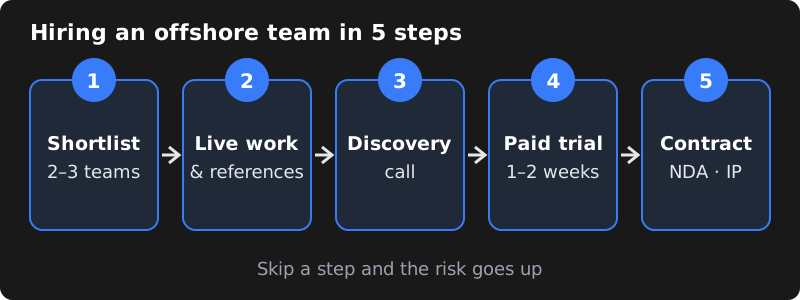
1. Check live work, not just screenshots
Ask for links to live websites and apps they built, and open them on your phone. Are they fast? Do forms work? Does the design hold up on a small screen? Screenshots and mock-ups are easy to borrow; live, working projects are much harder to fake.
2. Speak to past clients
Ask for one or two references you can email or call, ideally from your country or industry. Ask them: Did the team meet deadlines? How did they handle changes? Would you hire them again?
3. Look at how they communicate
During your first calls, notice whether they ask questions about your business and users, or simply agree to everything. A good team pushes back politely when something is unclear or unrealistic.
4. Review code or a technical write-up
If you are not technical, ask a trusted developer friend to review a code sample or a short technical approach document. You are looking for clean, readable code and sensible technology choices — not buzzwords.
5. Run a small paid trial
A one- or two-week paid task (for example, one feature or one page) shows you their real speed, quality and communication. It is the single best predictor of how the full project will go.
Contracts: NDA, IP and milestones
A clear contract protects both sides and prevents most disputes. At minimum, it should cover:
- Scope: a written list of features, pages and integrations, plus what is not included.
- Non-disclosure (NDA): your ideas, data and customer information stay confidential.
- Intellectual property: all code, designs and content are assigned to you once paid.
- Milestones and payments: for example, an advance to start, then payments tied to design approval, development complete and launch.
- Change requests: how extra work is estimated and approved before it starts.
- Support: a bug-fix period after launch and the cost of ongoing maintenance.
- Ownership of accounts: domain, hosting, app store and code repository accounts are registered in your company's name.
Communication and time zones
India Standard Time is UTC+5:30. That works better than many people expect if you plan around it.
| Your location | Typical overlap | What works well |
|---|---|---|
| UAE / Gulf | Most of the working day | Real-time calls and quick feedback |
| UK / Europe | Your morning, their afternoon | Daily stand-up in your morning, review in the evening |
| USA / Canada | A short agreed window | Work progresses overnight; review it in your morning |
| Australia / NZ | Your afternoon, their morning | Morning hand-offs from India, afternoon calls |
Agree a simple rhythm: a short weekly call, written daily or twice-weekly updates, and one shared place for tasks (Trello, Jira, ClickUp or even a shared sheet). Written updates matter more than meetings when time zones differ.
Paying an Indian team from abroad
International payments are routine for Indian development teams. Common options include:
- Bank transfer (SWIFT): best for larger invoices; check your bank's fees.
- Wise: usually transparent exchange rates and lower fees for many currencies.
- Payoneer: widely used by freelancers and agencies.
- PayPal: convenient for smaller amounts, but fees can be higher.
Whatever you use, pay against milestones and always receive a proper invoice. Fees and supported currencies change, so check each provider's current pricing.
Red flags to avoid
- They agree to everything without asking questions
- No live projects or references you can verify
- They ask for 100% payment upfront
- They want to host everything in their own accounts
- Quotes far below every other team, with no explanation
- No written scope, only a total price
- Different people on every call, and nobody owns your project
- Vague answers about testing and support after launch
Onboarding checklist for the first two weeks
- Share a short brief: your business, users, goals and competitors.
- Give access to brand assets, content and any existing systems.
- Create the code repository, project board and a shared chat channel.
- Agree the first milestone and what you will review at the end of it.
- Set the meeting rhythm and who approves decisions on your side.
- Confirm how bugs and change requests are reported and estimated.
Teams do their best work when they understand why they are building something, not just what. Ten minutes explaining your customers saves days of rework later.
What does an offshore team in India cost?
There is no single rate card. Cost depends on the developer's experience, the technology, whether you need design and project management included, and the engagement model. Rather than chasing the lowest hourly number, compare the total cost to get a working result, which includes your own management time and any rework.
| What you pay for | How it is usually priced |
|---|---|
| Defined project (website, store, MVP) | Fixed price, split into milestones |
| Ongoing development | Monthly fee per dedicated developer |
| Small tasks and fixes | Hourly, or a prepaid block of hours |
| Maintenance after launch | Monthly care plan |
For a deeper look at pricing, hidden costs and how to compare quotes, read Outsourcing Web Development to India: Costs, Risks and How to Choose.
Keeping quality high during the project
Hiring the right team is half the job. The other half is a simple working rhythm that catches problems early:
- Weekly demos: see working software every week, not just status reports.
- A staging site: review every change on a test copy before it goes live.
- Acceptance criteria: for each feature, write one or two sentences describing how you will know it works.
- One decision-maker on your side: conflicting feedback from several people is a common cause of delays.
- Prompt feedback: a team waiting two days for answers is a team that is idle or guessing.
Small, frequent reviews feel slower at first but are much faster than discovering a misunderstanding at the end of a three-month project.
Summary: hiring the right team
Choose the engagement model that fits your work, verify real projects and references, start with a paid trial, and put scope, IP and milestones in writing. Keep the code and accounts in your name, agree a communication rhythm that suits your time zone, and pay against delivered milestones. Do these things and an offshore team in India can become a long-term extension of your business.
Frequently asked questions
Is it safe to hire an offshore development team in India?
It is safe when you follow basic precautions: check live projects and references, sign an NDA and a contract that assigns intellectual property to you, pay against milestones, keep the code in a repository you own and make sure all accounts are registered in your name.
What time zone overlap can I expect with an Indian team?
India Standard Time is UTC+5:30. UK and UAE clients usually get several hours of natural overlap. US and Australian clients typically agree a fixed daily overlap window of 1 to 3 hours for calls, with the rest of the work happening asynchronously.
How should I pay an offshore developer in India?
Most international clients use bank transfer (SWIFT), Wise, Payoneer or PayPal. Pay a small advance and then against agreed milestones, and always get a proper invoice. Avoid paying the full project amount upfront.
Should I hire a freelancer, an agency or a dedicated team?
A freelancer suits small, well-defined tasks. An agency or small team suits complete projects that need design, development and testing. A dedicated developer or team suits ongoing work where you want the same people every month.
Who owns the code when I outsource development?
You should. Your contract must clearly assign all intellectual property to you on payment, and the code should live in a GitHub, GitLab or Bitbucket repository owned by your company from day one.
