Why outsource web development to India?
Businesses in the US, UK, Europe, the Middle East and Australia outsource web development to India for three main reasons: a large pool of experienced developers, strong English communication and a lower total cost than building an in-house team. Indian teams work with WordPress, Shopify, React, Next.js, Node.js, Python, Laravel, Flutter and most other modern technologies.
Outsourcing also gives you flexibility. You can bring in a full team for a three-month build, scale down to one developer for maintenance, and scale up again for the next phase — without hiring, training or redundancy costs. For agencies, an outsourced partner means you can say yes to more client work without adding permanent staff.
Time zones can even help: a team in India can make progress while you sleep, so you start each morning with new work to review. That only works, though, when requirements are written down clearly enough that the team does not need to wait for your answers.
The savings are real, but they are not automatic. The difference between a successful project and an expensive lesson usually comes down to how clearly the work is defined and how carefully the team is chosen.
What actually drives the cost
Two quotes for "a website" can differ by ten times because they describe different things. These are the factors that change the price most.
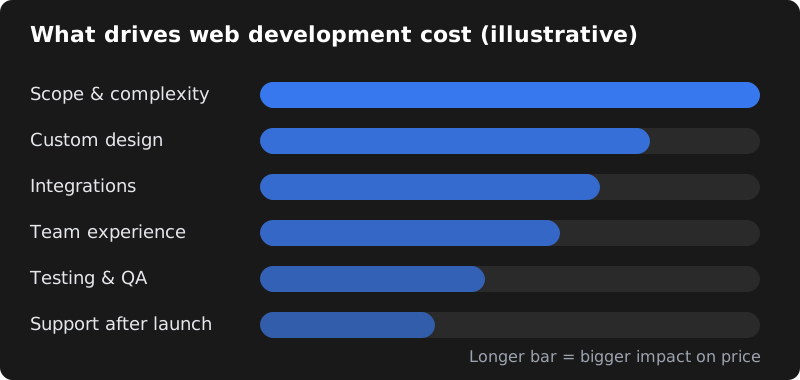
- Scope and complexity: number of pages or screens, user accounts, dashboards, payments and business logic.
- Custom design vs templates: a fully custom UI/UX takes far longer than adapting a quality theme.
- Integrations: CRMs, payment gateways, ERPs, WhatsApp, shipping or third-party APIs each add work and testing.
- Team experience: senior developers cost more per hour but usually deliver faster with fewer problems.
- Testing and quality: proper cross-device testing, security checks and performance work add time — and save money later.
- Support after launch: bug-fix periods, maintenance and hosting management.
Common engagement models
| Model | How you pay | Best for |
|---|---|---|
| Fixed price | One agreed price for a defined scope, paid in milestones | Websites, online stores and first versions of apps with clear requirements |
| Time and materials | Hourly or daily rate for actual time spent | Projects where requirements will evolve |
| Dedicated developer / team | Monthly fee per developer | Ongoing product development and long-term work |
| White label partnership | Per project or retainer, under your brand | Agencies reselling development services |
Indicative price ranges
Rates in India vary widely depending on the team's size, location, experience and the technology involved, so treat any range you see online — including this one — as a starting point only. Rather than quoting precise hourly figures that change constantly, here is how relative cost usually compares by project type:
| Project type | Relative cost | Typical timeline |
|---|---|---|
| Small business website (5–10 pages) | Low | 1–3 weeks |
| E-commerce store (WooCommerce / Shopify) | Low to medium | 3–6 weeks |
| Custom web application or portal | Medium to high | 2–4 months |
| Mobile app (Android + iOS) | Medium to high | 2–5 months |
| Ongoing dedicated developer | Monthly retainer | Ongoing |
For transparency, CodeServe publishes its own starting prices on our pricing page (in Indian rupees) — international projects are quoted in your preferred currency after a short call.
Hidden costs most buyers forget
- Your time: writing requirements, answering questions and reviewing work. Budget a few hours every week.
- Content: copywriting, product photos and translations are often not included.
- Third-party services: hosting, domains, premium themes and plugins, email services, app store accounts and paid APIs.
- Change requests: new ideas after the scope is agreed are normal — but they cost extra.
- Rework: unclear requirements lead to building things twice. This is the most expensive hidden cost of all.
- Maintenance: security updates, backups, monitoring and small changes after launch.
Risks and how to reduce them
| Risk | How to reduce it |
|---|---|
| Missed deadlines | Milestone-based plan, weekly demos, a staging site you can check anytime |
| Poor code quality | Code review by a third party, a short paid trial, agreed coding standards |
| Communication gaps | One named project manager, written updates, a shared task board |
| Losing access to your code | Repository, hosting and domain in your company's accounts from day one |
| Scope creep and surprise bills | Written scope with acceptance criteria and a change-request process |
| Data and IP concerns | NDA, IP assignment clause, least-privilege access to production systems |
How to compare quotes fairly
Put each quote into a simple comparison sheet and check:
- Exact features and pages included
- Design approach: template or custom
- Responsive design and browser testing
- Basic SEO and speed optimisation
- Number of revision rounds
- Timeline with milestones
- Bug-fix period after launch
- Who owns the code and accounts
- Hosting and third-party costs
- Named team members and their roles
The best value is usually the team that understands your business, explains trade-offs honestly and gives the most complete written scope — not the lowest number.
In-house vs local agency vs outsourced team
| Factor | In-house hire | Local agency | Outsourced team in India |
|---|---|---|---|
| Upfront commitment | High: recruiting, salary, benefits | Medium | Low: start with one project |
| Total cost | Highest over a year | High | Usually lower |
| Range of skills | Limited to who you hire | Broad | Broad: design, development, QA, DevOps |
| Time zone | Same | Same | Different: needs a clear rhythm |
| Scaling up or down | Slow | Moderate | Flexible |
Many businesses use a mix: one in-house product owner who knows the business well, with an outsourced team doing the design, development and testing.
Questions to ask before you sign
- Who exactly will work on my project, and what have they built before?
- Can I see two or three live projects similar to mine?
- What is included, and what is explicitly excluded, from this quote?
- How do you handle change requests and how are they priced?
- How will we communicate, how often, and in which time window?
- Will I have access to a staging site and the code repository throughout?
- What happens after launch: bug-fix period, maintenance and response times?
- How do you protect my data and who has access to production systems?
A confident, experienced team answers these questions clearly and in writing. Vague answers are a warning sign, however attractive the price.
A sample phased plan that keeps costs under control
Breaking a project into phases is the simplest way to control cost and risk. Each phase has its own scope, price and review, so you never commit to more than you can see working.
| Phase | What happens | What you review |
|---|---|---|
| 1. Discovery | Requirements, user flows, technical approach and estimate | A written scope and clickable wireframes |
| 2. Design | Visual design for key pages or screens | Approved designs before any code is written |
| 3. Build | Development in short sprints with weekly demos | Working features on a staging site |
| 4. Test and launch | Cross-device testing, fixes, speed and SEO checks, go-live | A launch checklist signed off by you |
| 5. Support | Bug-fix period, then maintenance or new features | Monthly report and priorities |
Paying a little for a proper discovery phase often saves far more later, because the estimate for the build is based on real, agreed requirements instead of guesses.
It also makes quotes easier to compare. When several teams estimate the same written scope, the differences in price usually come down to experience, design depth and how much testing is included — things you can now see and judge.
Choosing the right partner
Shortlist two or three teams, check their live work and references, and run a small paid task with your favourite. Agree a fixed-scope first phase, keep everything in your own accounts, and review progress every week. If the first phase goes well, you have found a partner you can grow with. For a step-by-step hiring process, read our guide on how to hire an offshore development team in India.
Frequently asked questions
How much does it cost to outsource web development to India?
It depends mainly on scope, the experience of the team and how much design and testing you need. A simple business website costs far less than a custom web application with user accounts and integrations. Always compare written scopes rather than headline prices, because quotes vary widely between teams.
Is the cheapest quote a good idea?
Rarely. Very low quotes often leave out design, testing, responsive layouts or support, or depend on inexperienced developers. The real cost then shows up later as rework, delays and extra management time.
Fixed price or hourly — which is better?
Fixed price works well when the scope is clear, such as a website or a defined first version of an app. Hourly or monthly retainers suit ongoing work and products where requirements change often.
What hidden costs should I budget for?
Plan for your own management time, content and copywriting, third-party services such as hosting, premium plugins, app store accounts and APIs, change requests outside the original scope, and maintenance after launch.
How do I reduce risk when outsourcing?
Start with a small paid trial, keep the code repository and accounts in your name, pay against milestones, agree a written scope with acceptance criteria and insist on a staging site where you can review work before it goes live.
